Project · energy markets
Hormuz Tracker
A live map of ship traffic through the Strait of Hormuz, covering the Persian Gulf and Gulf of Oman. It infers tanker and LNG trade disruption and surfaces it as one strait-status signal.
The insight
A simple ship count through the Strait of Hormuz can miss a disruption to oil and gas entirely. Tankers and LNG carriers get held up while ordinary traffic keeps the total looking normal. So the tracker follows the tanker and LNG fleet on its own. When that segment thins out, it's an early warning on energy supply, and on the wholesale-market moves that follow.
Context
Roughly a fifth of the world's oil and a large share of its LNG pass through the Strait of Hormuz. It's one of the most-watched chokepoints in energy. But "how many ships went through" is the wrong question. A busy strait can still mean stalled energy trade if the cargo mix has shifted. What matters is the cargo, not the count.
What I built
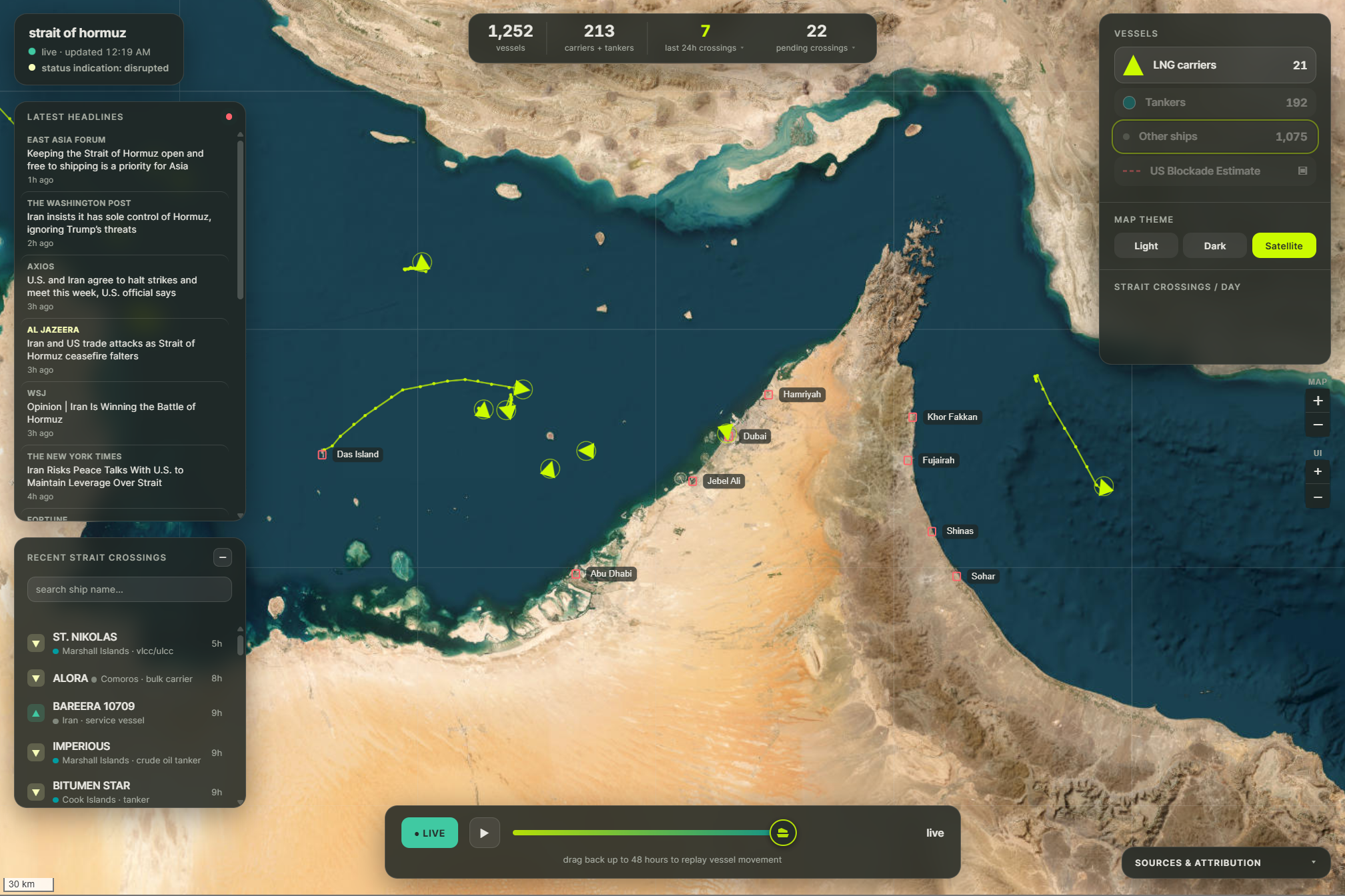
A live tracker of around 1,300 ships across the Persian Gulf and Gulf of Oman. It ingests AIS positions, classifies each ship by type, and watches the tanker and LNG segment specifically. From that it derives a single strait-status signal: a plain read on whether energy trade is flowing or under stress.
The data artefact
The map is the artefact. The headline is the status line above it: flowing when tanker and LNG movement holds against the baseline, escalating as it drops away. One status line replaces a thousand ship positions, so analysts and executives read the same signal.
Method
- Ingest live AIS ship positions across the Gulf region.
- Classify each ship; isolate tankers and LNG carriers from general traffic.
- Compare current tanker and LNG movement against a rolling baseline.
- Roll it up into one strait-status signal anyone can read.
Tech
- FastAPI
- Leaflet
- SQLite
- GCP VM